
The courage to be dust
on the definition of true grit, + ZOOM link for this week's Office Hours

Hi, I’m Deidre. Thanks for being here!
I’m an editor, a poet, and an M.Div student, and I’m currently writing my first book on the spiritual discipline of delight, which will come out next year. I offer Office Hours with an Editor twice a month for those who support my Substack with a paid subscription, and this is a totally open drop-in hour when we can talk publishing, book proposals, and any other writerly things that you want! Find the link at the bottom of this post.
Hope you’ll stick around!

I.
By the time I was in kindergarten, my education in Western movies was already very near complete.
My parents had no tolerance for childish slop; the brightly colored imagery and patronizing music of Barney and Friends (and its ilk) were sneezed upon in my household. I was more familiar with the Rooster Cogburns1 of the world than whatever my friends were watching on cable television, and that is probably why, under my senior portrait in the Presque Isle Class of 2010 yearbook, my life quote is not a lyric from a Carrie Underwood song nor a line from an Adam Sandler movie but rather a timeless proverb from one of Hollywood’s all-time greats:
Courage is being scared to death but saddling up anyway.
John Wayne
II.
“That’s what I’ve always liked about you,” my husband told me just yesterday.
“What?” I asked.
“You’ve always had spunk, and you’ve got a little chip on your shoulder.”
I balked. I do not have a chip on my shoulder.
“You do. Yeah. You know, like you’ve got something to prove. Nothing wrong with that.”
I do concede that, since I was a little girl hanging upside down from the swing set in our yard, I believed that life would be a total waste if every ounce of it wasn’t used up, wasn’t exciting, wasn’t full and vibrant and recognizably great.
And whenever I have felt scared, I have thrown back a shot of courage like a cowboy’s neat whiskey because the only thing more terrifying than the risk ahead was the threat of an obscure, humdrum life, particularly one lived in mediocrity.
I have supposed courage to mean something akin to seizing, wrangling, steering, saddling up.
You know. Cowboy stuff.
III.
Here is a confession.
For the last three years, I have been working on building a platform, which to say out loud feels shameful and low-brow. Cheap-like. It tastes like ash in my mouth.
But let me rush to my own defense to say I have not wanted a platform for the sake of being an influencer, or to make great deals of money, or, or, or. I have only set out to do what I intended from the start: to write a book.
It turns out publishers do not glorify obscurity. They like to see you out and about.
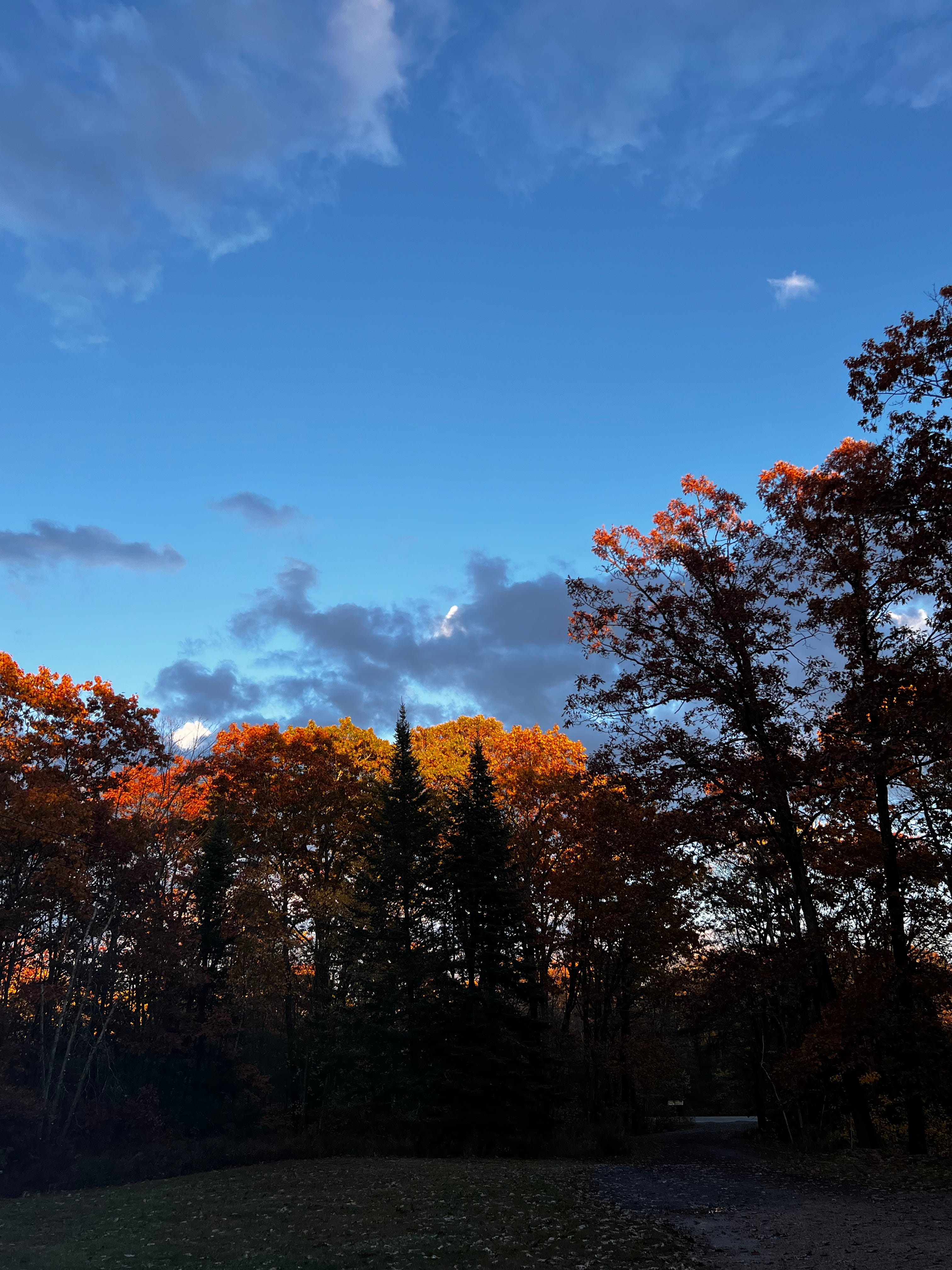
But my other confession is that somewhere in the middle of writing my manuscript, which I will turn into my editor at the end of May2, I looked out the window and fell into a dream-state. My dreams are so vivid these days. And in all my daydreams and all my nighttime dreams too now, I am anonymous. I am barefoot somewhere in the grass, or walking across well-worn pine in a cottage drenched with sun. I am lying on my back in the forest, watching the trees and the sky and the fungi from an angle that no walking woman could expect to see.
I am not someone who has ever gone viral, and through the lens of the publishing world, my “platform” is not large, not by a long shot. But there are small indications here and there that momentum is building, and it’s something I feel in my gut more than I see in statistics.
Yet my instinct is not to saddle up.
I thought it would be.
I had thought that was courage.
IV.
I shared this story from one of my seminary classes on Notes last week:
I asked one of my professors (who is much older, wiser, and more spiritually mature) this week how to stop caring what other people think.
“Will there be an age when I can expect this to happen?” I asked hopefully.
He said no.
My shoulders drooped.
But then he said, “I’ll tell you when it will happen. When you know with such certainty that you are doing what the Lord has called you to do, whether people criticize you or applaud you, it won’t matter anymore. You will still care. But it won’t matter.”
Here, here I think there lies a hint about courage. It seems to be a head-down sort of thing. An inner work. A hard-earned fortitude. E. Lily Yu might agree. In her book Break, Blow, Burn, and Make (which was so good I read it in two solid sittings last week), she writes:
In an age that emphasizes images, performativity, and visibility over the invisible and intangible, courage tends to be misconceived. It is not the absence of fear but the refusal to be conquered and controlled by fear. It is not rash behavior but a mature willingness to reckon up and pay the costs of one’s actions.3
It could be said that saddling up, at least the way I have done it, does not always come from a place of courage.
It could be said that saddling up is just the violent thrashing against the fear of being invisible, intangible.
V.
Wendell Berry ends his essay A Native Hill with the story of a leaf falling from the sky and getting caught on the button of his shirt.
At first it simply amuses him, but then “the event, among all its ramifying causes and considerations, and finally its mysteries, begins to take on the magnitude of history. Portent begins to dwell in it.”
He describes how, beneath the fallen leaf, his “breastbone burns with imminent decay.” In great (somewhat unnerving) detail, he begins to imagine his reunion with the earth, his slow-becoming of humus once more.
Yet after this sober-minded reckoning, he writes: “It is acceptable to me, and I am at peace.”4
He was 34 when he wrote those words, just as I am now.
VI.
I always thought that courage was to reach for something eternal, and expansive, and colorful, and wild. And in a way, I still do.
It’s just that I used to think it had something to do with riding half-blitzed on bravery toward the open frontier, ready to seize any ounce of life that came my way, and now I wonder if it’s not more like laying quietly in the leaves, looking boldly at our own limitations and fragility and learning to say, like Berry, “It is acceptable to me, and I am at peace.”
I’m starting to think that that’s true grit.
Details for this week’s Office Hour with an Editor:
What:
It’s kind of like office hours with a professor. The idea is you just drop in and I answer your questions about writing, publishing, editing, nonfiction book proposals, finding an agent, collaborating with other writers. That kind of thing. It’s casual. It’s fun. It’s friendly. And, I hope, it’s HELPFUL.
I offer these twice a month for paid subscribers.
When:
Thursday, March 5 from 12:30-1:30 PM (EST)
Where:
We’ll meet on Zoom. Let me know your name & email in the form below and I will send you the link to join the morning of our meeting.
A True Grit reference, for those who don’t share my upbringing
Good Lord willin’ & the creek don’t rise
E. Lily Yu, Break, Blow, Burn, and Make (Worthy Publishing, 2024), 147.
Wendell Berry, “A Native Hill” in The World-Ending Fire: The Essential Wendell Berry, e. Paul Kingsnorth (Counterpoint, 2017), 37.
Thank you for the honesty here. It’s daunting starting out with the foundling obscure desire to write a book i’m feeling like everyone else is so far ahead and has it all figured out. So thank you for sharing about the hard work. It has taken to build your platform through consistency and how that does not feel a effortless, but it does take courage. I enjoyed the whole essay and all you had to say. The Windberry quote is both chilling and comforting.
I love to hear the effects of your own reading and writing on your internal wrestlings and to hear them processed on the page. You know they speak to the message of the Village Poet as well🫶🏻 Also: long live John Wayne — and Bonanza!🤠