
Where's God?
...maybe hiding in plain sight

Hi, I’m Deidre. Thanks for being here! I’m an editor, a poet, and an M.Div student, and I’m currently writing my first book on the spiritual discipline of delight, which will come out next year. I offer Office Hours with an Editor twice a month for those who support my Substack with a paid subscription, and this is a totally open drop-in hour when we can talk publishing, book proposals, and any other writerly things that you want! Hope you’ll stick around!
I.
I saw this cartoon a couple of weeks ago of somebody saying, “I don’t believe in God. I can’t see him anywhere.”
Meanwhile, their face was pressed squarely into the side of his leg.
I wish I could find it to show you, because now the image is pressed so squarely into the side of my brain that I can’t stop thinking about it. What felt humorous at first glance has now gotten out of hand—to me it has turned into a giant theological question:
If we can’t see God, could it be because he is actually so intimately involved in our lives that we are like that cartoon character—feeling alone but rather entirely surrounded by the orchestrations of heaven?
II.
Oh, this is a slippery and wily idea.
It’s like the little frog we tried to catch in the flower garden last summer. He was there sure enough: Theo and Vivian and I all saw him. We lunged at him and touched his soft wet body and his legs brushed through our fingers before he was somehow five feet away from us again, on the far end of the rhubarb. We didn’t want to possess him of course. We only wanted to get a good look at him, to understand him in his completeness rather than only the passing glances we’d been afforded.
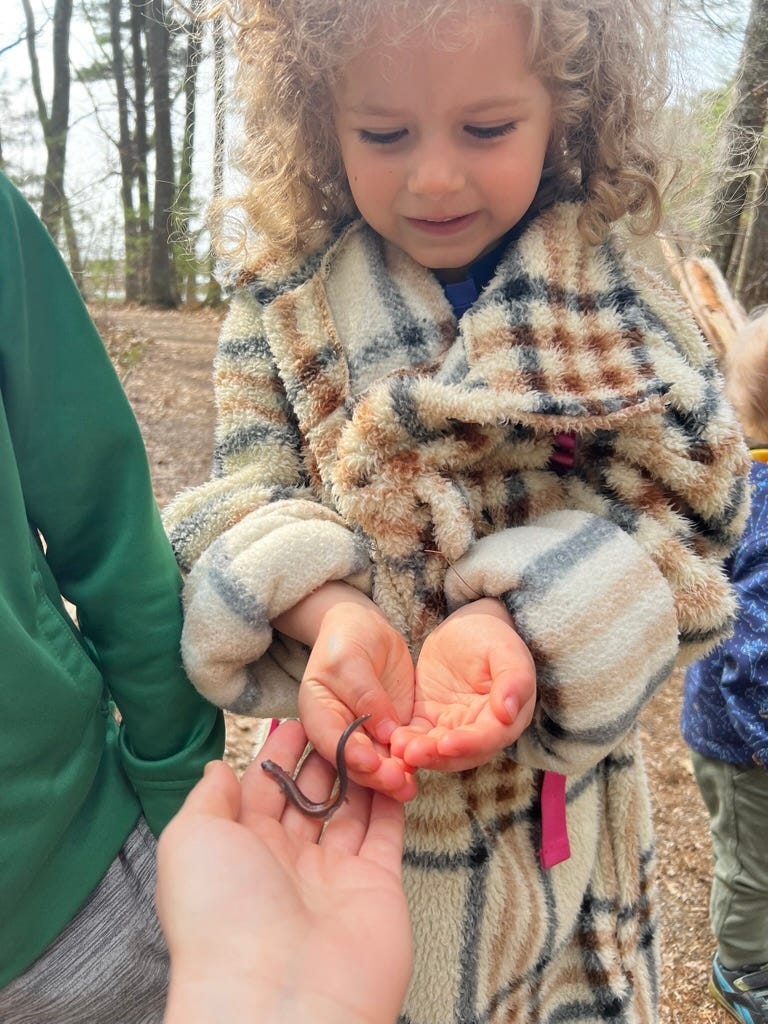
When I try to get a hold of this idea, it is the little frog.
But I know there is something lively about it, something I long to hold in my hands and witness.
I think about St. John of the Cross talking about the dark night of the soul. It sounds ominous. It is ominous. It is when you can’t feel God all of a sudden. Once you could, now you can’t. In fact you can’t feel much of anything anymore. St. John said that when this happens, it is because:
God now sees that they have grown a little, and are becoming strong enough to lay aside their swaddling clothes and be taken from the gentle breast; so He sets them down from His arms and teaches them to walk on their own feet; which they feel to be very strange, for everything seems to be going wrong with them.1
So it is not an abandonment, like the theory of God as Clockmaker that I learned about once in my high school English class. He does not wind the machine and then walk away until it stops ticking.
Instead maybe it is more like when my children are following me so closely that I look to the left and the right and all around and grow frantic because I don’t see them—only to find them nearly clinging to my leg.
III.
I wrote this poem once, and it won’t behave.
I don’t actually believe that we only exist as ideas in God’s mind, only that we existed as ideas in his mind before he made us tangible, and also that we are now always held in his mind the way a parent always keeps their child at the front of their brain. But for fear of being misunderstood it has been banished to my desk drawer, where it gets pushed further and further back as new rejects get stuffed in.
But it comes back to me now. I dig it out. I wonder if there’s anything to it.
“You know, some people think God holds the whole universe inside his mind,” she says, and I hold my swig of black coffee inside the orb of my mouth for an extra beat.
And I just about turn my brain inside out trying to grasp the concept that the lurking creatures in the leagues of the sea are mere goldfish in the fishbowls of God’s frontal lobe and that the wild west cowboys ran their horses all along the fissures of God’s skull, and that black holes loop from his prefrontal cortex to his hippocampus, where the warehouses are filled with pools of love and women like me kneel beside their babies’ beds and kiss their hands and feet and eyelashes and knuckles and say things like, “Please God, please. Hold them.”
And if these prayers are just as near his own thoughts and they channel from his brain to his ears and heart then our entire existence must be Yes and Amen, because of course we are held and of course we are found, if it is true in fact that we live inside God’s mind.

IV.
Perhaps you’ve also read the poem Footprints in the Sand.
I feel like it’s quite popular in the waiting rooms of doctor’s offices. It is by a poet named Mary Stevenson, and I am intimately familiar with this poem because it was, for whatever reason, on my husband’s wall when we were dating way back in high school. I chuckle to think of that now; I guess it could have been Sports Illustrated models. I’m glad it wasn’t.
Anyway, the poem goes like this:
One night, the author’s life plays out before her eyes. Alongside every major life event, she also sees an image of footprints in the sand: sometimes there are two sets, but she notices that in the very lowest seasons of her life, there is only one. So she cries to the Lord something like, “Why weren’t you there when I needed you most?”
That is when he tells her: “You only see one set of footprints in the sand because those were the times I was carrying you.”2
V.
A theologian from Harvard named Harvey Cox wrote a book called The Feast of Fools, where he explores the theology of and spiritual necessity for festivity.
According to him, there are three main ingredients needed to make something truly festive:
Excess
Celebration
Juxtaposition
And it’s this idea of juxtaposition I can’t get away from. Of this element he writes:
Juxtaposition…makes us more conscious of the continuity of history by allowing us to step back from it temporarily. It provides a contrast, a Copernican point where we can stand while we hold the workaday environment temporarily at bay. In this way the world we hardly see because we are so absorbed in it periodically becomes visible.3
Have you ever been in a building where there is some sort of white noise—an air conditioner, a dryer, machinery at work outside—and it is not until the moment it stops running that you realize it was ever happening in the first place?
I think what Cox is saying is something like that. That some things are so familiar and so utterly consistent in our lives that unless there is some sort of distance from them, we cannot even be aware, at least fully, of their existence.
Could it be like that with God? Paul wrote that he was persuaded that…
neither death nor life, nor angels nor rulers, nor things present nor things to come, nor powers, nor height nor depth, nor any other created thing will be able to separate us from the love of God that is in Christ Jesus our Lord.4
Could it be that when we are in those dark nights of the soul that we are not abandoned, but rather that his love is so unbelievably intertwined with our existence that we struggle to see it at all?
When we can’t perceive God in our lives, could it be it’s because our faces are actually pressed into the side of his leg?
What a deliciously comforting thought.
St. John of the Cross, Dark Night of the Soul, chapter VIII.
Mary Stevenson, Footprints in the Sand. https://www.footprints-inthe-sand.com/index.php?page=Poem/Poem.php
Harvey Cox, The Feast of Fools (Harvard University Press: 1969), 24.
Romans 8:38-39 (CSB)
Your words were so timely for me today, as someone walking through a long season of feeling like God is hard to find. It seemed to be a reminder from the Father to look up from that leg I have my face pressed into and see His face looking into mine!
This reminds me of a quote I saw the other day! It says, "No, you're not 'running from God'. He's in front of you. You're running laps on a track and He is sitting in the inner field waiting for you to tire yourself out and come sit with Him."
SUCH a beautiful word, Deidre. Thank you for sharing!